Rules of Astral Wandering
The Mystery of The Invisible DogRules of Astral Wandering describe a proposed ability to perceive the world apart from the sleeping physical body, while apparently having no power to alter it. Presented by Professor Eugenia Lantine as a possibility supported by a small number of laboratory observations, the rules offer an explanation for how Sonny Elmquist might know things he could not ordinarily have seen. Their decisive distinction is between access to information and the ability to act: a wanderer may observe, but the evidence suggests that observation does not make the person a physical intruder.
Definition and Conditions
Professor Eugenia Lantine explains that a true wanderer leaves the body while asleep and moves about in a form she calls the astral body. The ability is associated with sleep rather than deliberate waking activity. Her account also allows that the experience may not be under the wanderer’s control: Bob Andrews later reports that the person may go wherever he wants, or even somewhere he does not consciously intend to go, but that the extent of such control is uncertain. The possibility that a person can be in two places at once is therefore an explanatory description, not a fully specified mechanism.
The phenomenon is presented as rare in recorded laboratory research. Professor Lantine says that people who experience it seldom enter a laboratory; they may keep the episodes private, fear that they are losing their minds, or interpret them as second sight. Her account consequently rests on limited opportunities for controlled study, a qualification that matters when the investigators apply it to a specific case. She does not claim that every unusual dream is astral wandering, or that the proposed ability has been established as a general law.
The Laboratory Demonstration
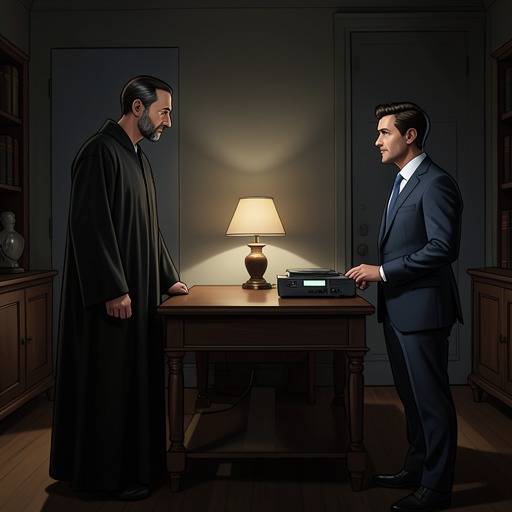
To show what the hypothesis might explain, Professor Lantine describes a woman who reported recurrent dreams in which she witnessed real events taking place far away, in circumstances where she had no ordinary means of knowing what was happening. The university kept her for several days at Ruxton University and observed her sleeping through a one-way window. The experiment tested not merely whether she could describe an unusual experience, but whether she could acquire information placed beyond her ordinary reach.
For the first night, a ten-digit number was typed at random by a secretary in another office. The secretary did not look at the number, folded the paper, and put it in an envelope. That envelope was placed on a shelf above the woman’s bed, too high for her to reach; she knew it was there, but not what it contained. In the morning, she could describe the envelope, including the blob of blue sealing wax, but could not identify the number. She had remained in bed throughout the night.
The researchers then changed the condition of the test. A janitor opened the envelope without looking at the paper and placed the paper face up on the shelf. The woman slept beneath it for a second night. This time she gave the ten-digit number correctly, and the researchers checked her answer against the paper. According to Professor Lantine, she had not moved during the night. The contrast between the two results is central to the proposed rules: she could perceive the envelope while its contents were concealed, but could report the number only after the paper was exposed.
Limits on Physical Agency
The demonstration supports a distinction between seeing and handling. The woman’s first-night description suggests access to the envelope’s visible features, while her inability to read the sealed number indicates that the supposed astral perception did not disclose what the paper concealed. Once the number was visible, she could report it, but she still did not reach for the paper or move it. The account thus gives the ability a specific boundary: it may provide perception beyond the sleeping body, but does not appear to let the wanderer manipulate physical objects.
Professor Lantine describes wanderers as observers and says that, so far as the researchers know, they apparently cannot move anything. Her phrasing preserves uncertainty. The experiment is evidence for a possible capacity and a possible limitation, not proof that every wanderer behaves identically or that the limits have been exhaustively tested. She also tells Bob Andrews that observed experiments with Sonny Elmquist might support the hypothesis, but might prove nothing. The rules remain provisional even within the story’s explanation.
That limitation separates astral wandering from ordinary burglary. A wanderer might apparently pass through a locked door, or reach a place the physical person could not enter, but such access would not amount to opening drawers, shifting objects, or stealing property. The investigators’ speculation about walls and locked doors is an inference from the proposed separation of astral and physical presence; the more firmly stated rule is the inability to move things. The distinction prevents the supernatural explanation from doing more work than the evidence permits.
Application to Sonny Elmquist
After Bob Andrews reports what he learned at Ruxton University, Jupiter Jones considers whether Sonny Elmquist could be wandering while asleep. The hypothesis could account for Elmquist knowing that Fenton Prentice owned a mandala and perhaps knowing about the Carpathian Hound: he might have overheard Prentice speaking by telephone with Mr Niedland, then encountered the information in a sleep-related episode. But knowledge alone does not establish that he committed the burglary. If the proposed restriction on physical agency holds, Elmquist could not have removed the object; moreover, Jupiter notes that Elmquist was asleep when the burglary occurred.
The same reasoning addresses the changes inside Prentice’s apartment. Since Prentice took the door key away from Mrs Bortz, nothing had been disturbed. Prentice identifies Mrs Bortz as the person who had opened drawers and moved things around. The contrast gives the rule a concrete consequence: the earlier physical rearrangements had a human cause, while Elmquist’s possible wandering might account for observation without explaining any movement. The investigators use the model to distinguish two kinds of apparent access rather than collapsing them into one suspicion.
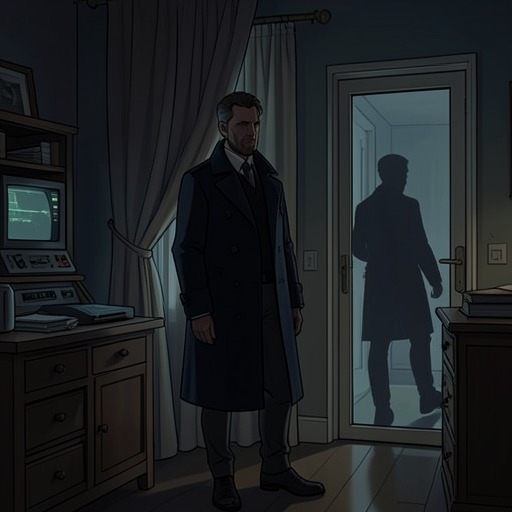
At the confrontation over the recovered dog, Jupiter tells Prentice that Elmquist does not know about the ten thousand dollars and is not the burglar; he is only a wanderer who happened to see something in his sleep. Elmquist turns pale and admits that he dreams things he cannot help dreaming. He describes a glass dog and a dream of someone entering in the dark late at night and putting it into the water, though he could not see who did it. His account fits the rules’ emphasis on involuntary observation and incomplete knowledge: he has seen an event in a dream, but cannot identify the person responsible, and his perception does not make him the person who moved the dog.
Explanatory Role and Uncertainty
The rules turn a seemingly impossible form of knowledge into a limited clue. They explain how Elmquist could know about objects or events without being able to enter an apartment physically, disturb its contents, or carry away the Carpathian Hound. At the same time, they do not identify the burglar or reveal everything Elmquist saw. His dream supplies an image of the dog being placed in water, but leaves the actor unseen; astral perception, as described here, can expose information while leaving decisive gaps.
The account therefore preserves a tension between a supernatural-sounding explanation and cautious reasoning. Professor Lantine’s controlled example gives the idea evidentiary shape, while the small number of cases and the uncertain prospect of testing Elmquist prevent it from becoming an unquestionable scientific rule. Jupiter accepts it because it fits the facts better than the alternative of two identical people in the same building for months, not because the mechanism has been conclusively demonstrated. The rules matter most as a boundary: they make extraordinary observation conceivable without confusing it with physical power or guilt.